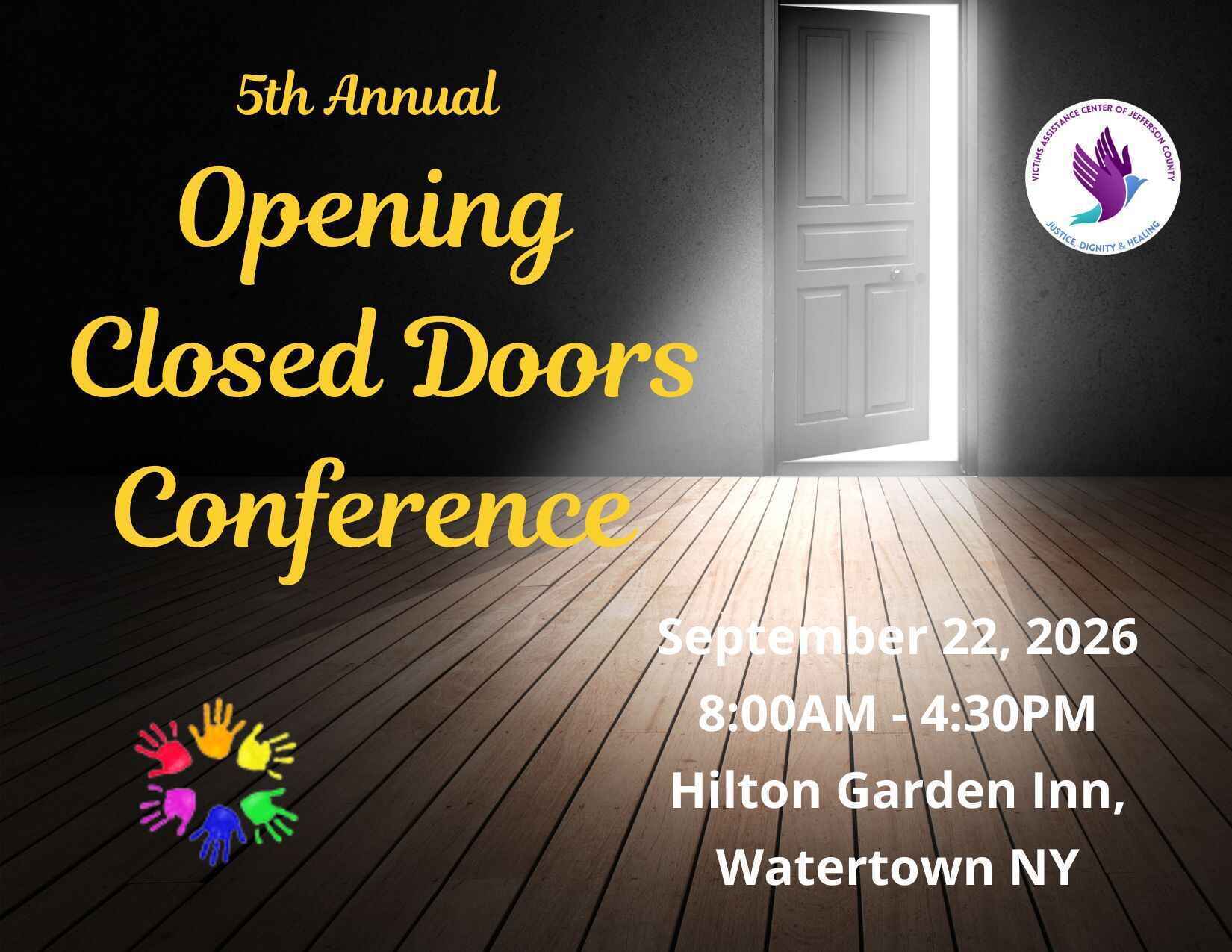
5th Annual Opening Closed Doors Conference
September 22, 2026 @ 8:00AM — 4:30PM Eastern Time (US & Canada) Add to Calendar
Hilton Garden Inn: 1290 Arsenal St Watertown, NY 13601 Get Directions
Opening Closed Doors: Bringing Domestic Crimes to Light
The Victims Assistance Center of Jefferson County's Child Advocacy Center of Northern New York invites you to attend our 5th Annual "Opening Closed Doors: Bringing Domestic Crimes to Light" Conference. Join us for a full day of presentations bringing together school personnel, medical providers, law enforcement, prosecution, social workers, and community members to discuss the latest research, prevention strategies, and trauma-informed care practices.
Victims Assistance Center of Jefferson County, Inc.
Child Advocacy Center of Northern New York
Presents our 5th Annual Conference:
OPENING CLOSED DOORS: Bringing Domestic Crimes to Light
Tuesday, September 22, 2026
Hilton Garden Inn, Watertown NY
AGENDA:
8:00a-8:25a: Registration & Lite Breakfast, provided by Hilton Garden Inn
8:25a-8:30a: Welcoming Remarks
8:30a-10:00a: Keynote Speaker (Main Room): Gaelin Elmore - Be The Difference: Belonging Is The Support We Need
Description: What determines if an individual is a “success” story or a “cautionary” tale? Is it talent? Is it resilience or grit? Is it simply luck? Gaelin Elmore knows that stories of caution and success have more things in common than we’d care to admit. He knows because he lived it. Mr. Elmore’s powerful story has motivated and inspired thousands, but instead of using his story to focus on “success,” he uses it to shed light on the importance of belonging and “support.” Throughout this keynote, attendees will be challenged and inspired to be individuals who CARE about belonging, because belonging is ‘the difference’ between a story of success and a tale of caution.
10:00a-10:15a: Morning Break
10:15a-11:45a:
- Break Out Room #1 (Main Room): Gaelin Elmore - The Belonging Need: Understanding Belonging To Go From Surviving To Thriving
Description: Belonging is a crucial, innate need that influences our daily decisions, motivation, problem-solving, and overall well-being. Genuine belonging fosters resilience and positive health outcomes in us, and those that we serve. This workshop addresses the power of belonging through the 4-directional model; internal, horizontal, vertical, and external. This workshop will empower participants to embrace belonging and bridge the gap for others while offering a fresh perspective and intention for impactful work.
Takeaways:
·Why belonging is a fundamental need for everyone
·How belonging impacts development
·Why belonging matters in the workplace
·And how belonging allows us to successfully serve in our roles
- Break Out Room #2 (Mid-Size Room): Andrew Campbell - School Shooters and Adverse Childhood Experiences (ACEs)
Description: Participants will learn of findings from the presenter’s detailed analysis, review, and ongoing study of the perpetrators of 69 school shooting incidents occurring in the U.S. since 1999. Topics include expanding the list of adverse childhood experiences, appropriately responding to children in “emotional distress”; the relationship between harm in the home and committing acts of violence in the community; child perpetration of animal cruelty; bullying and its impact on child mental health; religion and school shooters; the impact of observing violence in books, video games, and movies; commonalities in childhood histories of school shooters vs serial murderers and perpetrators of other acts of targeted violence (not occurring at schools); and preventing future acts of violence in the community.
- Break Out Room #3 (Small Room): Dr. Jodi Mullen - Children, Domestic Violence and Play Therapy
Description: Millions of children across the globe experience violence in their homes. Growing up in a violent home may be a terrifying and traumatic experience that can affect every aspect of a child’s life, growth and development. In this workshop, participants will learn how play therapy addresses and mitigates the effects of domestic violence on children. Developmental and cultural issues relevant with this population will be addressed and many practical skills and case conceptualization will be demonstrated.
- Meeting Room: "Zen-Den" - Sometimes, you just need to take a break from reality!
11:45a-12:30p: Break : Lunch provided by Hilton Garden Inn (Main Room)
12:30p- 1:30p: Plenary Speaker (Main Room): Salka Valerio – Beyond the Headlines: Understanding Human Trafficking Through a Survivor-Informed Lens
Description: This presentation will focus on human trafficking awareness through a survivor-informed lens, including the realities of trafficking, how individuals are groomed and exploited, what trafficking can look like today, and how communities can recognize warning signs and support survivors. Salka will also share parts of her lived experience to help bring a deeper understanding of the issue.
1:30p- 1:35p: Switch Rooms
1:35p- 3:05p:
- Break Out Room #1 (Main Room): Gaelin Elmore - The Belonging Need: Understanding Belonging To Go From Surviving to Thriving
Description: Belonging is a crucial, innate need that influences our daily decisions, motivation, problem-solving, and overall well-being. Genuine belonging fosters resilience and positive health outcomes in us, and those that we serve. This workshop addresses the power of belonging through the 4-directional model; internal, horizontal, vertical, and external. This workshop will empower participants to embrace belonging and bridge the gap for others while offering a fresh perspective and intention for impactful work.
Takeaways:
·Why belonging is a fundamental need for everyone
·How belonging impacts development
·Why belonging matters in the workplace
·And how belonging allows us to successfully serve in our roles
- Break Out Room #2 (Mid Size Room): Andrew Campbell - More Than Words: The Emotional Maltreatment of Children
Description: This presentation will discuss the specific threats of physical, psychological, and emotional harm for children living in a home where partner abuse/domestic violence occurs. Common misconceptions will be addressed, including the idea that a child can be too young to be affected by abuse in the home, physically observable signs of injury are an appropriate estimator of victimization, and the idea that children who do not actually see a violent act occur are not significantly harmed by it.
- Break Out Room #3 (Small Room): Caitie Dahl, Zero Abuse Project -Corroborating Evidence: For Prosecutors, Law Enforcement, Forensic Interviewers, and Other MDT Members
Description: Initial child abuse disclosures and children’s statements ascertained through the forensic interview are only one part of an entire investigation. Increasing the corroboratively relevant details in the interview will assist in other parts of the child abuse investigation. This training stresses the importance of corroboration and offers forensic interview techniques to increase forensically relevant corroborative details in the interview through interview considerations, sample language and guidance for the multidisciplinary team approach.
Learning Objectives: 1. Increase relevant corroborative details in the forensic interview. 2. Identify the multidisciplinary team’s role in supporting the forensic interviewer to increase the relevant corroborative details in the forensic interview. 3. Practice implementing the multidisciplinary team and forensic interview approach to promoting corroboration through scenario exercises.
- Meeting Room: "Zen-Den" - Sometimes, you just need to take a break from reality!
3:05p-3:15p: Afternoon Break - Snacks and Refreshments provided by Hilton Garden Inn
3:15p-4:15p:
- Break Out Room #1 (Main Room): Rachel Countryman - An Interactive MDT Response to Strangulation
Description: Strangulation cases rarely involve a single discipline. From the initial 911 call through the investigation, medical assessment, advocacy, and child protection considerations, successful outcomes depend on a coordinated multidisciplinary response. Using a realistic case scenario, participants will work through key decision points, discuss agency roles, and explore how communication and collaboration influence victim safety and case outcomes. This interactive session is designed for professionals across the multidisciplinary team.
- Break Out Room #2 (Mid Size Room): Andrew Campbell - "Someday" Never Comes: Breaking Generational Cycles of Familial Abuse
Description: This presentation will highlight key concepts for ending generational cycles of familial abuse, explore how concepts from initiatives to end generational cycles for other public health issues are also relevant, explain the importance of working at this issue from both directions (separate but equally effective programs for victims and perpetrators) and identify key areas of intervention for family violence professionals (law enforcement, court systems, animal welfare, education, medical, faith-based, etc.) in efforts to end abuse in the home. Ending generational cycles of familial abuse not only results in improved health outcomes for all humans and animals who currently reside in the home, but for the generations who follow as well.
- Break Out Room #3 (Small Room): Caitie Dahl, Zero Abuse Project - Developing Effective MDTs: Playing Nice In The Sandbox
Description: This workshop summarizes the history of developing MDTs in the United States and then, armed with that history, discusses the ten greatest challenges facing MDTs today and offers concrete suggestions for MDTs in meeting these challenges.
Learning Objectives: 1. Gain a better understanding of the history for MDT development and best practices in the field of child abuse investigations, 2. Discuss the top ten challenges nationally facing MDTs, 3. Learn concrete suggestions for overcoming challenges among MDT team members.
- Meeting Room: "Zen-Den" - Sometimes, you just need to take a break from reality!
Certificates **these will be on the registration table for attendees to grab on their way out**
CEU's Available